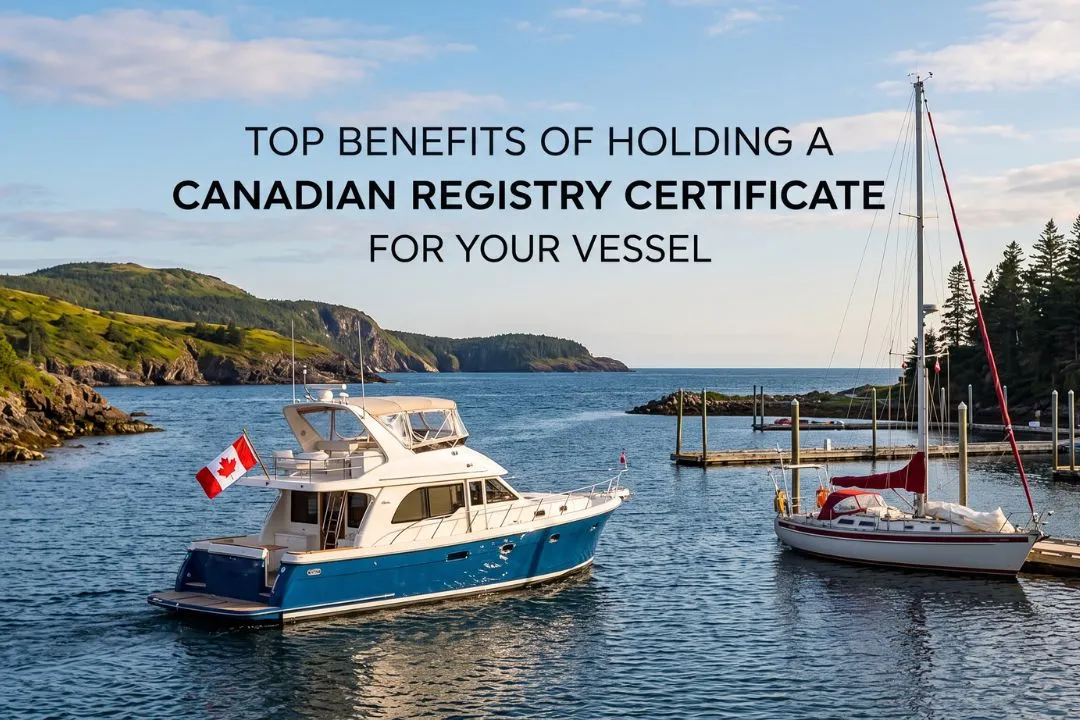
What are the main benefits of holding a Canadian Registry Certificate for a vessel?
Under the Canada Shipping Act, 2001 (Part 2), holding a Canadian Registry Certificate provides unassailable proof of legal ownership, grants the right to fly the Canadian flag internationally, and guarantees Canadian diplomatic and consular protection in foreign ports.
Full registration reserves an exclusive nationwide vessel name, assigns a permanent Official Number (O.N.), and is a mandatory prerequisite for recording preferred marine mortgages with financial institutions or operating commercially in Canadian waters.
Transport Canada Documentation Frameworks Compared
| Registration Framework | Pleasure Craft Licence (PCL) | Small Vessel Register (SVR) | Full Canadian Vessel Registration |
| Primary Purpose | Basic domestic search & rescue identification | Commercial operation for hulls < 15 Gross Tons (GT) | Full legal title, global flag rights, & marine mortgage recording |
| Legal Proof of Title | No (Administrative ID only) | Partial (Commercial regulatory compliance) | Yes (Definitive legal title under Canada Shipping Act, 2001) |
| International Flag Rights | Domestic waters / US boundary waters only | Canadian commercial waters | Full right to fly the Canadian Flag & receive global diplomatic protection |
| Vessel Naming Rules | Non-exclusive (multiple boats can share names) | Registered business or hull number ID | 100% Exclusive Nationwide Name (cannot be duplicated in Canada) |
| Preferred Marine Mortgages | Cannot be recorded | Limited commercial financing | Mandatory for recording preferred bank mortgages |
| Hull Marking Requirement | Exterior bow numbers (3-inch block characters) | SVR number on exterior bow | Permanent interior marking (Official Number & Net Tonnage) |
How Does a Canadian Registry Certificate Protect Legal Title and Mortgages?
For mariners navigating international boundary waters or seeking marine financing, a Pleasure Craft Licence (PCL) is legally insufficient. Under the Canada Shipping Act, 2001, full vessel registration enters your craft into the Canadian Register of Vessels, establishing an unassailable public record of title.
Legal & Financial Advantages
- Definitive Legal Proof of Ownership: Unlike a state or provincial licence, a Certificate of Registry serves as court-admissible proof of ownership during domestic title disputes or foreign customs inspections.
- Recording Preferred Marine Mortgages: Major charter lenders and Canadian financial institutions require full vessel registration prior to issuing marine loans. This allows the bank to register a preferred marine mortgage against the official title abstract, protecting both the lender’s security interest and the buyer’s equity.
- Global Diplomatic & Consular Protection: Flying the Canadian flag grants your vessel international recognition under maritime law, simplifying foreign port clearances and guaranteeing access to Canadian consular support worldwide.
What Are the Official Hull Marking Rules for Registered Vessels?
Once approved by Transport Canada, a registered vessel receives an Official Number (O.N.) and net tonnage designation that must be permanently affixed to the craft before the Certificate of Registry is finalized.
O.N. 123456 N.T. 12
Interior and Exterior Marking Standards
- Permanent Interior Marking: The Official Number (e.g., O.N. 123456) and Net Tonnage (e.g., N.T. 12) must be marked on a main internal structural member (such as a transverse frame, main beam, or bulkhead) in plain block characters at least 3 inches (7.6 cm) high.
- Permanence Requirement: The markings must be carved, glassed, stamped, or burned into the hull so that removal or alteration would cause visible structural damage, serving as a powerful theft deterrent.
- Exterior Transom Markings: The approved, exclusive vessel name alongside the designated Port of Registry (e.g., Vancouver, BC or Halifax, NS) must be clearly displayed on the exterior hull (typically the transom) in legible characters not less than 4 inches (10 cm) in height.
Exclusive Vessel Naming and Port of Registry Designations
Choosing a name during the full registration process reserves that title across the entire country:
- 100% Nationwide Name Exclusivity: Transport Canada verifies that no other registered vessel in Canada shares your exact approved name, preserving brand identity and resale equity.
- Official Port of Registry: Owners select an official Canadian Port of Registry (such as Montreal, Toronto, Victoria, or St. John’s), anchoring the vessel to a recognized maritime jurisdiction.
- Immutable Public History: All structural modifications, ownership transfers, and satisfied mortgages are permanently logged in the central database, generating a clean Abstract of Title that enhances resale market value.
Commercial Operational Eligibility & Small Vessel Registration
Operating a vessel for commercial gain, including passenger charters, bareboat rentals, commercial fishing, or cargo transport, requires compliance with Transport Canada’s commercial mandates.
- Commercial Endorsements: Vessels over 15 Gross Tonnage (GT) must hold full Canadian Vessel Registration with appropriate commercial trade endorsements (Coastwise, Passenger, or Non-Passenger).
- Small Vessel Register (SVR): Commercial craft under 15 Gross Tonnage (GT) powered by motors of 10 HP or more can utilize the streamlined Small Vessel Register for non-pleasure operations.
- Statutory Fine Avoidance: Operating a commercial vessel without proper Transport Canada registration or endorsement can result in severe administrative monetary penalties (AMPs) and vessel detention by marine safety inspectors.
How the National Vessel Registry Center Corp. Streamlines Applications
Navigating federal maritime paperwork requires precise adherence to Transport Canada guidelines. The National Vessel Registry Center Corp. provides an intuitive web portal to manage all documentation milestones:
- Initial Vessel Registration: Fast-track filing for first-time registrations, importing foreign hulls, or upgrading from a Pleasure Craft Licence.
- Recording & Discharging Marine Mortgages: Official submission of preferred marine mortgages and lien satisfaction documents for lenders and buyers.
- Transfer of Ownership & Name Changes: Processing bill of sale documentation, managing managing-owner updates, and reserving new vessel names.
- Document Reinstatements & Transcripts: Requesting official Abstracts of Title, certified duplicate certificates, and vessel deletion papers for export.
Frequently Asked Canadian Registry Certificate Questions
Q: What is the difference between a Pleasure Craft Licence and a Canadian Registry Certificate?
A: A Pleasure Craft Licence (PCL) is a free domestic identification number required for recreational boats powered by 10 HP or more; it does not prove legal ownership or grant flag rights. A Canadian Registry Certificate provides definitive legal title under the Canada Shipping Act, 2001, reserves an exclusive nationwide name, allows the vessel to fly the Canadian flag internationally, and enables marine mortgage recording.
Q: Is a Canadian Registry Certificate required to get a boat loan in Canada?
A: Yes. Most Canadian banks and marine lenders require full registration in the Canadian Register of Vessels before issuing a major loan. Registration allows the lender to record a preferred marine mortgage directly against the vessel’s official title abstract.
Q: Where must the Official Number (O.N.) be marked on a registered Canadian boat?
A: The assigned Official Number and Net Tonnage must be permanently carved, glassed, burned, or stamped onto an interior structural member (such as a main transverse beam or bulkhead) in block characters at least 3 inches (7.6 cm) in height.
Q: Can two registered boats in Canada have the same name?
A: No. Transport Canada enforces strict nationwide name exclusivity for fully registered vessels. Once a vessel name is approved and registered, no other craft in Canada can hold that exact name.