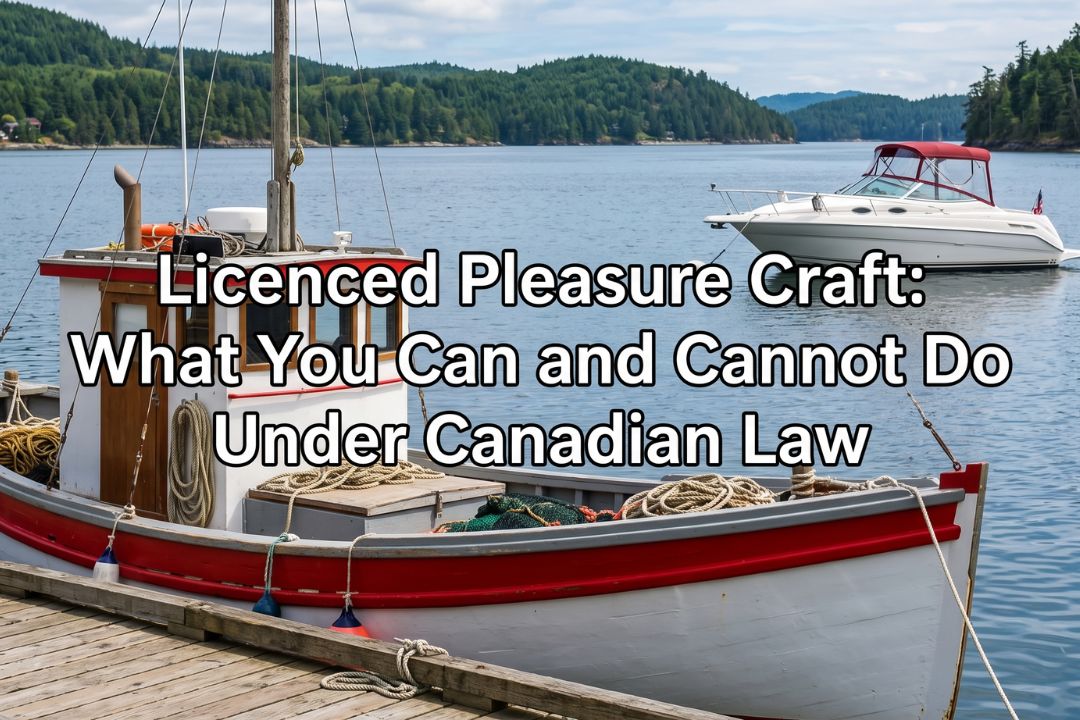
Operating a boat for recreation in Canada comes with responsibilities that owners should understand before heading onto the water. A licenced pleasure craft is subject to specific federal requirements, including rules concerning its use, identification, ownership information, and the qualifications of the person operating it.
A Pleasure Craft Licence (PCL) is an identification document for qualifying recreational boats; it is not the same thing as registration under the Canadian vessel registration system.
Recreational Activities Permitted With a Pleasure Craft Licence
A PCL is intended for boats principally operated and maintained in Canadian waters for recreational purposes. For power-driven pleasure craft, licensing requirements generally apply when the boat has one or more engines totaling at least 10 horsepower (7.5 kW). The licence gives the boat an identification number and helps authorities identify the boat and its owner information.
A properly licenced pleasure craft can generally be used for activities such as:
- Cruising on Canadian lakes, rivers, and coastal waters
- Family boating trips
- Recreational fishing
- Water skiing and other recreational towing activities
- Sightseeing and leisure trips
- Personal transportation on the water
- Overnight recreational trips
- Non-commercial outings with friends and family
- Recreational use of personal watercraft when applicable licensing requirements are met
The PCL number must be displayed on both sides of the bow in the manner required by Transport Canada. The number serves an identification purpose and can assist authorities during enforcement activities or emergencies.
A PCL Does Not Establish Ownership
One of the most important distinctions for boat owners is that a Pleasure Craft Licence is not proof of ownership. Transport Canada describes the licence as an identification document rather than an ownership document.
This means owners should not treat the licence as a substitute for other records that establish how a boat was acquired. It also means a PCL should not be confused with Canadian registration.
Canadian registration is a separate federal system with different purposes and requirements. The Canada Shipping Act, 2001 establishes rules for registration, while separate provisions govern pleasure craft licensing.
At National Vessel Registry Center Corp., we keep these services distinct. Our online portal provides the forms you can use for the Transport Canada service appropriate to your situation rather than suggesting that a PCL and Canadian registration are interchangeable.
Activities That Fall Outside Recreational Use
A Pleasure Craft Licence is designed for recreational boating. It does not by itself authorize a boat owner to conduct a commercial operation.
For example, owners should not assume that having a current PCL gives them permission to:
- Carry passengers for compensation
- Operate paid sightseeing excursions
- Conduct commercial fishing activities
- Provide charter services for payment
- Transport goods as a commercial business
- Rent the boat for commercial operations
- Use the boat as part of a business without meeting applicable requirements
Commercial operations can involve different regulatory obligations, including requirements concerning the boat, its operation, safety standards, and registration or other documentation. The Canada Shipping Act, 2001 gives the federal government authority to establish regulations concerning pleasure craft licensing and the operation and safety of pleasure craft.
A recreational licence should therefore not be viewed as a shortcut around commercial requirements. If the way you intend to use your boat changes, you should determine which Transport Canada requirements apply before beginning the new activity.
PCL and Commercial Operations Are Separate Issues
It is also important not to assume that changing the paperwork automatically changes the legal character of an operation. The rules depend on factors such as how the boat is used and whether it meets the applicable definition and regulatory requirements.
For owners considering commercial activity, the safest approach is to review the requirements that apply to the proposed operation rather than relying solely on an existing PCL.
Identification Requirements for Licensed Boats
A licensed boat must display its assigned licence number as required by federal law. The Canada Shipping Act, 2001 prohibits operating a pleasure craft requiring a licence unless the licence number is marked on the boat and maintained in the required manner.
Owners should make sure the number remains:
- Clearly visible
- Properly positioned
- Legible
- Maintained in the required format
- Unaltered or unobscured
The law also prohibits defacing, altering, concealing, or removing a licence number. These requirements make the number more than an administrative detail: it is an identification feature associated with the licensed boat.
A current licence number can also be useful when authorities need to identify a boat. Transport Canada notes that PCL information can help police and search-and-rescue personnel identify boats and access relevant owner information.
Operator Requirements Are Separate From the Boat Licence
Having a current PCL does not automatically establish that every person onboard is qualified to operate the boat. The boat licence and operator competency are separate requirements.
A person operating a power-driven pleasure craft generally needs proof of competency, such as a Pleasure Craft Operator Card (PCOC), where required. The operator requirements are established separately under the Competency of Operators of Pleasure Craft Regulations.
This distinction is useful for families and groups that share a boat. The licence belongs to the recreational boat, while competency requirements apply to the person operating it.
Before allowing someone else to take the helm, owners should consider whether that individual has the required proof of competency and whether the operator understands applicable safety requirements.
Safe Operation Remains the Owner’s Responsibility
A PCL does not replace the responsibility to operate a boat safely. Under the Canada Shipping Act, 2001, operators must ensure that pleasure craft meet the applicable regulatory requirements. Enforcement officers may also stop and board a pleasure craft when the statutory conditions for doing so are met.
Owners should therefore pay attention to requirements involving:
- Required safety equipment
- Operator competency
- Navigation rules
- Applicable speed restrictions
- Local waterway requirements
- Weather and operating conditions
- Passenger safety
- Proper maintenance of the boat
Licensing is one part of responsible recreational boating, not a substitute for the broader safety obligations that apply on Canadian waters.
Keeping Pleasure Craft Information Current
Transport Canada’s current PCL program provides for five-year validity for new, transferred, and renewed licences. Licence information must also be updated when certain information changes, including the owner’s name, address, contact information, or relevant pleasure craft details. Transport Canada currently requires these updates within 30 days.
Owners should pay attention to changes involving:
- A change of address
- A change in contact information
- A change in the boat’s relevant details
- A change in ownership
- An approaching licence expiry date
If ownership of a licenced pleasure craft changes, the new owner must have the licence transferred before operating the boat, subject to the applicable rules. Transport Canada currently specifies a 30-day timeframe for transferring a PCL following an ownership change.
Updating, Transferring, and Renewing Your PCL
Keeping your PCL information current is an ongoing responsibility rather than a one-time task. Transport Canada provides separate processes for new applications, transfers, renewals, updates, replacements, and cancellations.
The terminology associated with these services is worth keeping clear:
- A PCL update concerns changes to information associated with an existing licence.
- A PCL transfer concerns a change in ownership.
- A PCL renewal concerns extending the licence after its applicable validity period.
- A replacement may be needed if the licence document is lost or damaged.
- A cancellation may be appropriate when the licence is no longer required.
At National Vessel Registry Center Corp., our role is to make these Transport Canada processes easier to navigate by providing the applicable forms through our online portal. We do not replace Transport Canada or determine whether an application satisfies federal requirements. Instead, we give boat owners a convenient way to access the forms they need and use their own information to request the service they require.
When Canadian Registration May Be More Appropriate
A PCL should not automatically be treated as the appropriate federal credential for every boat or every purpose. Canadian registration is a separate system with different legal functions.
For example, Transport Canada explains that a pleasure craft may need registration rather than a PCL in circumstances such as when the owner wants to give the boat a registered name or register a marine mortgage. Registration can also become relevant when a boat is being used in circumstances that fall outside ordinary recreational use.
The Canada Shipping Act, 2001 separately establishes mandatory registration requirements for certain vessels that are not pleasure craft and meet the statutory conditions.
How Our Online Portal Helps With PCL Services
At National Vessel Registry Center Corp., we focus on making federal boat documentation services more convenient to access. Our online portal provides forms for services involving Canadian boat registration, pleasure craft licencing, and related Transport Canada processes.
For owners managing a PCL, we can make it easier to access the appropriate form when they need to:
- Apply for a new PCL
- Transfer an existing PCL
- Renew a PCL
- Update PCL information
- Request a replacement
- Cancel a PCL when appropriate
Our service does not change Transport Canada’s requirements, and submitting a form does not guarantee approval. The information supplied by the applicant remains the basis for the application.
The key is choosing the Transport Canada service that matches what you actually need. A Pleasure Craft Licence identifies a qualifying recreational boat, while Canadian registration serves a separate legal and administrative purpose.
What Owners of a Licenced Pleasure Craft Should Keep in Mind
A current PCL allows qualifying recreational boat owners to satisfy the federal licensing requirement applicable to their boat, but it does not create unlimited operating privileges.
Owners with a licenced pleasure craft should remember that:
- Recreational use and commercial use are treated differently.
- A PCL is not proof of ownership.
- A PCL is not the same as Canadian registration.
- The licence number must be properly displayed.
- Operator competency requirements are separate from boat licensing.
- Licence information should remain current.
- Ownership changes require the appropriate transfer process.
- New and renewed PCLs have a five-year validity period under the current program.
- Other federal, provincial, territorial, and local boating requirements may also apply.
For recreational owners, keeping the correct Transport Canada information current is a practical part of responsible boat ownership. Our online portal gives you a convenient way to access the forms associated with the PCL services you need, while keeping the distinction between pleasure craft licencing and Canadian registration clear.