Personal pleasure watercraft licence summary for Canadian boaters:
Licensing Threshold: Any pleasure craft with engine power totaling 10 HP (7.5 kW) or greater requires a Pleasure Craft Licence (PCL).
Cost/Penalties: Operating without a valid licence carries a $250 minimum fine .
Validity: Licences are valid for 5 years and are issued under Transport Canada’s Small Vessel Regulations.
Licence vs. PCOC: A Pleasure Craft Licence identifies the boat (hull numbers); a Pleasure Craft Operator Card (PCOC) certifies the driver.
To review the foundational statutory rules governing Canadian maritime transport, boaters can access Canada’s Shipping Legislation. Adhering to these federal provisions helps protect all users sharing Canadian waterways.
Utilizing a streamlined online portal simplifies filing paperwork, allowing boat owners to spend less time managing administrative tasks and more time enjoying the open water safely.
Determining Licensing Thresholds for Personal Watercraft and Jet Skis
Meeting federal motor power thresholds determines whether your recreational craft requires mandatory licensing before hitting the water.Understanding these rules ensures boaters maintain full compliance with Transport Canada regulations.
Motor Power Limits and Engine Capabilities
The primary factor determining whether a craft requires licensing is its total engine propulsion power. Under federal rules, any recreational boat fitted with an engine or multiple engines totaling 10 horsepower (7.5 kW) or more must carry a valid licence. This rule applies regardless of whether the engine is an inboard, outboard, stern drive, or jet drive unit.
Even small inflatable boats or rowboats modified with small gasoline or electric motors trigger this requirement once the total power reaches or exceeds the 10 HP threshold.
Personal Watercraft Classification Rules
Personal watercraft, commonly known as PWCs, fall directly under federal pleasure craft licensing regulations. Consequently, virtually every personal watercraft operating on Canadian inland or coastal waters must be properly licensed before being launched.
- Motorized craft under 10 HP (7.5 kW) are exempt from mandatory pleasure craft licensing requirements.
- All personal watercraft with engines reaching or exceeding 10 HP must hold a valid licence.
- Electric outboard motors contributing to a cumulative power output of 10 HP or more also trigger mandatory licensing.
- Licensing requirements apply equally across all Canadian provinces, territories, inland lakes, and coastal waterways.
Federal Enforcement and Non-Compliance Penalties
Marine safety officers, including the Royal Canadian Mounted Police (RCMP), provincial police forces, conservation officers, and the Canadian Coast Guard, actively enforce licensing rules across Canadian waterways.
Operating a qualifying motorized boat without displaying valid licence numbers can lead to immediate citations. The standard administrative fine for operating an unlicensed pleasure craft is $250, plus applicable regional court surcharges, making prompt compliance through proper form submission both practical and necessary.
Application Documentation, Side-View Photographs, and 5-Year Validity Cycles
Mandatory Proof of Ownership and Identification
When applying for a licence, boat owners must submit documentation establishing clear legal ownership. Acceptable proof includes a signed Bill of Sale, a signed agreement, a court order, or a statutory declaration confirming ownership details.
In addition to proof of ownership, applicants must provide a clear copy of a valid government-issued photo identification document, such as a driver’s licence or passport, to verify the owner’s legal name, date of birth, and primary address.
What Do You Need to Apply for a Canadian Pleasure Craft Licence?
To complete a Pleasure Craft Licence (PCL) application via online portals or Transport Canada, you must prepare three core documents:
- Proof of Ownership: Signed Bill of Sale, statutory declaration, or court order displaying seller signature, buyer name, and full craft description.
- Valid Government-Issued Photo ID: Current driver’s licence or passport verifying full legal name and date of birth.
- Compliant Side-View Photograph:
Full side profile from bow to stern.
Waterline clearly visible.
High-resolution, unedited color image with zero visual obstructions.
Managing Five-Year Renewals and Operating Permits
Once approved, a pleasure craft licence remains valid for a period of five years. At the conclusion of this cycle, owners must complete a PCL update to keep their contact details and boat information accurate within federal databases.
If you purchase a pre-owned craft that already holds an active licence number, you must apply for a PCL transfer to update ownership records under your name.
The National Vessel Registry Center Corp. provides access to online portal forms for initial applications, renewals, updates, and transfers.
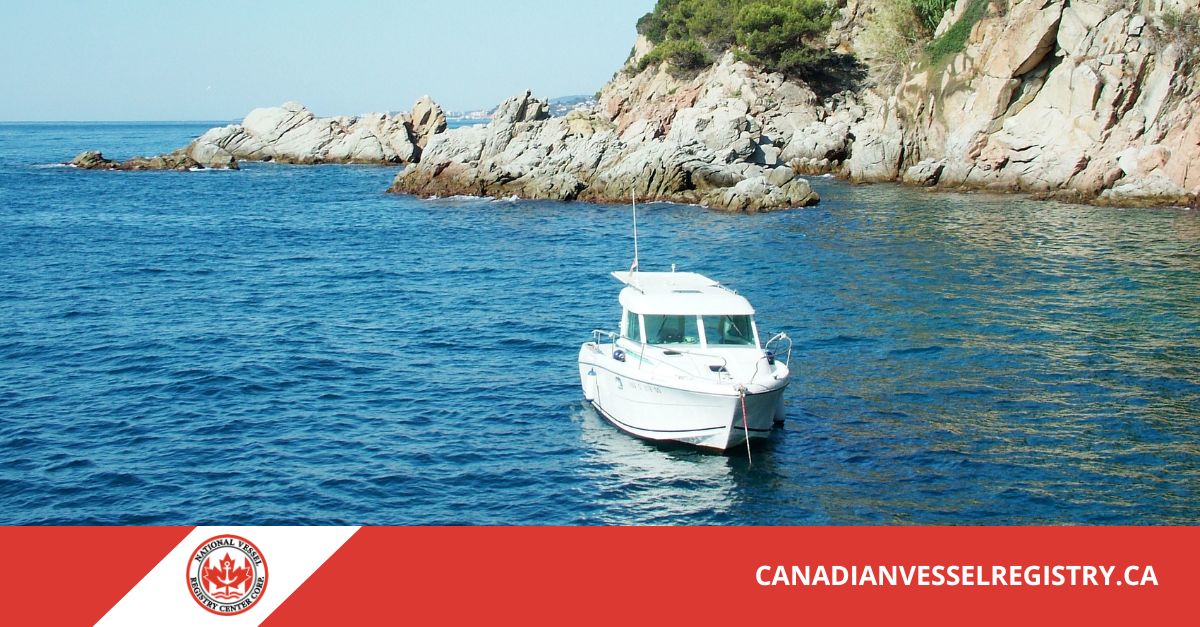
Proper Bow Number Display Standards vs. Operator Competency Cards
Correctly displaying assigned licence characters on your boat’s hull is a strict legal requirement under federal law. Boaters must also recognize the distinct operational differences between boat licensing and personal operator certifications.
Size, Color, and Placement Rules for Bow Numbers
Once a licence number is assigned, the boat owner is legally required to mark the numbers directly on the craft’s hull. The digits must be displayed on both sides of the bow, situated well above the waterline so they remain clearly visible at all times.
Federal standards require the characters to be at least 7.5 centimeters (3 inches) in height, formatted in plain block lettering, and written in a color that sharply contrasts with the background color of the boat’s hull.
Licensing the Craft versus Certification of the Operator
A common point of confusion among boaters is the distinction between a pleasure craft licence and a Pleasure Craft Operator Card (PCOC). A pleasure craft licence identifies the boat itself, functioning similarly to a motor vehicle licence plate.
Conversely, a Pleasure Craft Operator Card identifies the driver, serving as proof that the individual has passed an approved boating safety course. Carrying a licence for your boat does not exempt you from holding personal operator credentials while driving the craft.
- Bow numbers must be permanently affixed using vinyl decals or weather-resistant paint.
- Character height must measure a minimum of 7.5 cm (3 inches) with bold, block-style proportioning.
- Contrast must be stark, such as black lettering on a white hull or white lettering on a dark hull.
- All operators driving a motorized recreational boat must carry proof of competency, such as a PCOC.
Safety Inspections and Law Enforcement Verification
During routine marine safety stops, law enforcement officers inspect both physical hull markings and operator documentation. Officers verify that the assigned numbers match current federal registry entries and that the driver possesses valid operator credentials.
Ensuring your boat displays proper bow markings prevents unnecessary delays during safety checks and helps search and rescue organizations locate craft during emergency situations.
Personal Pleasure Watercraft Licence Frequently Asked Questions
What motor size requires a licence on a Canadian pleasure craft?
Any recreational boat fitted with one or more motors totaling 10 horsepower (7.5 kW) or greater must carry a valid licence, unless it is formally registered in the Canadian Register of Vessels. This mandate applies to all motorized craft, including personal watercraft, Sea-Doos, and conventional motorboats operating on inland or coastal waters.
Is a pleasure craft licence the same as a Pleasure Craft Operator Card?
No, they are entirely different requirements. A pleasure craft licence identifies the specific boat and displays assigned numbers on the hull, while a Pleasure Craft Operator Card (PCOC) certifies that the individual driving the craft has completed mandatory boating safety education. Operators must hold a PCOC regardless of whether the boat itself carries a licence.
How does a pleasure craft licence differ from formal boat registration?
A personal pleasure watercraft licence/pleasure craft licence is a basic identification system for recreational craft that does not provide legal title proof or mortgage recording options. Formal boat registration under the Canadian Register of Vessels or Small Vessel Register provides legal title, proof of Canadian ownership, and official naming rights, serving distinct commercial or navigation purposes.