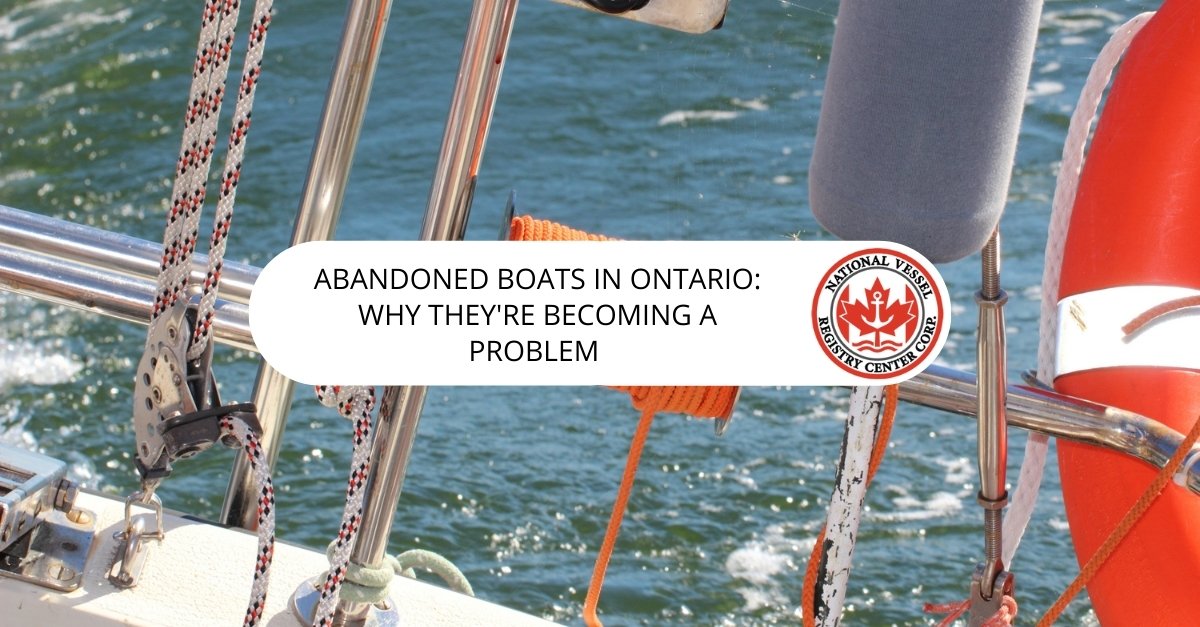
For boat owners, leaving an unwanted craft unattended may seem like an easy way to avoid the expense of repairs, storage, or disposal. However, abandoned boats in Ontario can create legal, environmental, and financial problems for owners and communities.
Canadian law places responsibilities on people who own or operate boats, particularly when a boat becomes a hazard, is deliberately abandoned, or is left in poor condition for an extended period.
Legal Liabilities Under the Wrecked, Abandoned or Hazardous Vessels Act
The federal Wrecked, Abandoned or Hazardous Vessels Act (WAHVA) provides a framework for dealing with boats that have been abandoned, wrecked, or become hazardous. The legislation gives authorities tools to address problem boats while also establishing responsibilities for owners.
The rules can apply in several situations, including when an owner:
- Leaves a boat behind without making appropriate arrangements
- Allows a boat to deteriorate until it becomes a wreck
- Purposely sinks, strands, or grounds a boat
- Leaves a boat in poor condition in the same general area for more than 60 consecutive days without authorization
- Allows a boat to remain adrift for more than 48 hours without taking reasonable measures to secure it
Transport Canada explains that the WAHVA can result in administrative monetary penalties of up to $50,000 for individuals and up to $250,000 for corporations. More serious offences prosecuted through the courts can carry substantially higher fines, including maximum fines of $1 million for individuals and $6 million for corporations.
Owners Can Remain Responsible for Removal Costs
The potential financial exposure does not necessarily end with a penalty. Under the legislation, an owner of a boat or wreck can be liable for certain costs and expenses incurred by the federal government when measures are taken in relation to the boat.
That can make neglecting an aging boat particularly risky. A boat that appears to have little value may still create substantial expenses if it becomes a navigation, safety, or environmental problem.
The WAHVA also provides enforcement mechanisms for situations where authorities believe that a violation has occurred. Depending on the circumstances, this can involve a notice of violation, an administrative monetary penalty, or prosecution for an offence.
For boat owners dealing with an aging or unwanted craft, taking care of ownership and Transport Canada paperwork before problems develop can be a much more practical approach than simply leaving the boat behind.
Environmental Risks to Ontario Lakes, Rivers, and Coastal Ecosystems
The environmental consequences associated with abandoned boats in Ontario can extend well beyond the immediate location of the boat. Ontario has an extensive network of lakes, rivers, canals, and Great Lakes shoreline, meaning a neglected boat can potentially affect recreational waterways, wildlife habitat, and navigation.
A deteriorating boat may contain materials that should not enter the water, including:
- Gasoline or diesel fuel
- Engine oil
- Hydraulic fluids
- Batteries and associated materials
- Paint and coatings
- Cleaning chemicals
- Plastics and other deteriorating components
When a boat begins taking on water or sinks, these materials can become more difficult to contain. A submerged or partially submerged boat can also create a physical hazard for other boaters, particularly in areas with heavy recreational traffic.
Pollution Is Not the Only Concern
Environmental damage is only one part of the problem. A derelict boat can also:
- Obstruct channels or access points
- Damage docks, shorelines, or other property
- Create hazards for swimmers and other recreational users
- Become increasingly difficult and expensive to remove
- Deter visitors from waterfront areas
- Break apart and leave debris throughout a waterway
The federal government specifically identifies environmental and navigational concerns as reasons for addressing wrecked, abandoned, and hazardous boats. The WAHVA gives authorities powers to respond to boats that present hazards and establishes responsibilities for owners.
For this reason, simply allowing a boat to deteriorate because it is no longer being used is not necessarily a harmless decision.
How to Report or Safely Deal With an Abandoned Boat
If you encounter abandoned boats in Ontario, resist the temptation to tow, remove, sell, or otherwise take control of the boat yourself. Finding a boat does not automatically make the finder its legal owner.
The WAHVA establishes a Receiver of Wreck process, and Transport Canada states that a person generally cannot take possession of a wreck before reporting it to the Receiver of Wreck unless an exception applies, such as an immediate need to secure or protect the wreck.
Information That Can Help Identify a Boat
If you discover a potentially abandoned boat, useful identifying details may include:
- The boat’s name, if displayed
- Registration or licence numbers
- Hull identification information
- The location where it was found
- Whether it is floating, grounded, or submerged
- Visible damage or hazardous conditions
- Photographs showing its condition and surroundings
Providing accurate identifying information can make it easier for the appropriate authorities to determine what should happen next.
Do not assume that a boat is legally abandoned merely because nobody appears to be nearby. It may have an identifiable owner, may have been lost, or may be subject to another legal issue.
Ownership Records and Transport Canada Systems
A situation involving an apparently abandoned boat can become complicated when ownership records are incomplete or outdated. A person who finds a boat cannot simply claim ownership and immediately apply for registration or licencing.
Different Transport Canada systems serve different purposes. For example, the PCL is used as an identification system for eligible recreational boats, while registration is a separate federal system with its own requirements. Neither system automatically gives a finder ownership of an abandoned boat.
The same distinction applies to the small vessel register. It is a registration system with specific eligibility and regulatory requirements; it is not another name for pleasure craft licencing.
These distinctions can become especially relevant when a boat has an old identification number but no readily apparent owner. The appropriate records and legal process need to be considered before any ownership application is submitted.
Federal Rules and the Canada Shipping Act
The WAHVA operates alongside other federal marine legislation. The Canada Shipping Act, 2001 includes provisions covering registration, pleasure craft licences, safety, pollution prevention, enforcement, and other aspects of Canadian boating.
The Act includes separate parts dealing with registration, listing and recording, as well as pleasure craft licences.
For owners, this reinforces the need to identify the specific Transport Canada service that applies to a particular boat rather than treating every form of federal boating documentation as interchangeable.
How We Make Transport Canada Applications Easier
The issue of abandoned boats in Ontario involves more than an unwanted piece of property sitting on the water. A neglected boat can become a financial liability, an environmental threat, a navigation hazard, and a source of enforcement action.
At National Vessel Registry Center Corp., we provide Canadian boat owners with online access to forms used for Transport Canada-related applications. Our role is to make the process of accessing and completing the appropriate forms more convenient through our online portal.
When dealing with a boat that is changing ownership, being registered, or requiring another type of Transport Canada application, having access to the correct form can make the administrative process more straightforward.
Our online services include access to forms associated with:
- Boat registration applications
- Ownership transfers
- Replacement certificates
- Changes to registry information
- Pleasure craft licencing applications
- Other Transport Canada boating forms available through our portal
We do not determine whether an abandoned boat legally belongs to someone, authorize salvage, or replace the legal process established by Canadian authorities. Those questions must be addressed through the appropriate governmental channels.
Instead, once you have established the appropriate legal pathway, our service makes it easier to access the forms needed for the applicable Transport Canada application.
Avoiding Problems With an Aging or Unwanted Boat
The best way to avoid the complications associated with abandoned boats in Ontario is to address a boat’s status before it becomes a hazard.
If you no longer want your boat, consider the condition of the craft, its ownership status, where it is located, and what legal obligations may apply. Leaving it at a dock, shoreline, marina, or other location without proper arrangements can create consequences that continue long after you stop using it.
Boat owners should also avoid assuming that sinking an unwanted boat solves the problem. Intentionally sinking, stranding, or grounding a boat can fall within the conduct prohibited by the WAHVA.
Keeping your Transport Canada records current can also make future transactions less complicated. If you need to access a form for a registration, transfer, replacement certificate, or pleasure craft licencing application, our online portal provides a convenient way to access the applicable forms.
Protect Your Boat, Your Records, and Ontario’s Waterways
Federal law provides authorities with significant powers to address boats that are abandoned, wrecked, or hazardous, while owners can face penalties and responsibility for certain costs.
If you own a boat that you no longer use, do not assume that leaving it behind is a simple solution. Address its ownership and legal status through the appropriate channels, and use the proper Transport Canada process when an application is required.
By taking action before a neglected boat becomes a larger problem, owners can reduce unnecessary complications and help keep Ontario’s waterways safer and cleaner. For anyone encountering abandoned boats in Ontario, the appropriate authorities should be contacted rather than attempting to remove or claim the boat independently.